
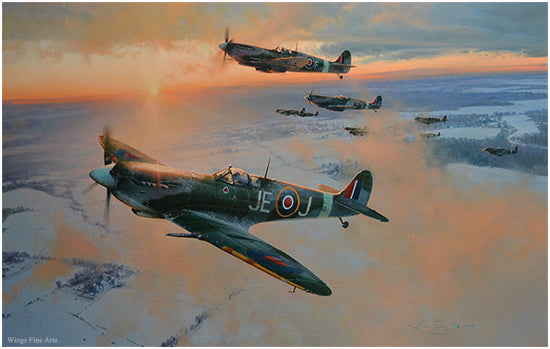
Overview
James Edgar "Johnnie" Johnson was a legendary RAF fighter pilot who became the top-scoring Allied ace of World War II with 38 confirmed victories, all against single-engined fighters. His exceptional skill, courage, and leadership made him one of the most respected fighter pilots in aviation history.
Early Career
Johnson's path to becoming a legendary ace was not without obstacles. He attempted to join the RAF three times unsuccessfully in 1938 before finally beginning pilot training in September 1939.
He was posted to 616 Spitfire Squadron during the Battle of Britain. A pre-war shoulder injury initially threatened his flying career, but after hospitalization, he returned to operational duty in spring 1941, ready to make his mark on history.

Learning from the Best
Johnson studied under Douglas Bader, the legendary legless ace who commanded his wing. He later stated that Bader "taught us the true meaning of courage, spirit and determination." This mentorship would prove invaluable throughout his distinguished career.
Combat Achievements
First Command — July 1942
Given command of No. 610 Squadron, marking the beginning of his distinguished leadership career.
Dieppe Raid — 1942
Flew four sorties during the raid, claiming one confirmed kill and one shared victory, demonstrating his exceptional combat skill under intense pressure.
Kenley Wing — 1943
Commanded Spitfire fighters with extraordinary success. His personal tally reached 25 victories while the Canadian wing he led added 60 more to their collective score.
No. 144 Wing — March 1944
Given command of No. 144 Wing, the first fighter unit based in Europe after D-Day, leading from the front during this crucial period.
Final Victory — September 27, 1944
Achieved his 38th confirmed kill, cementing his status as the top-scoring Allied fighter ace of World War II.

Distinguished Service & Legacy
Johnson's combat record was extraordinary: he completed 515 operational sorties with only one confirmed hit to his aircraft — a testament to his exceptional flying skill and tactical awareness.
He was promoted to Group Captain in March 1945 and remained in the Air Force until 1964, retiring as Air Officer Commanding Middle East Forces.
After his military career, Johnson became recognized as a leading expert on WWII air power and authored several books on air-fighting tactics, sharing his knowledge and experience with future generations of aviators.